২৯/১/২০২৬
শেয়ার করুন:
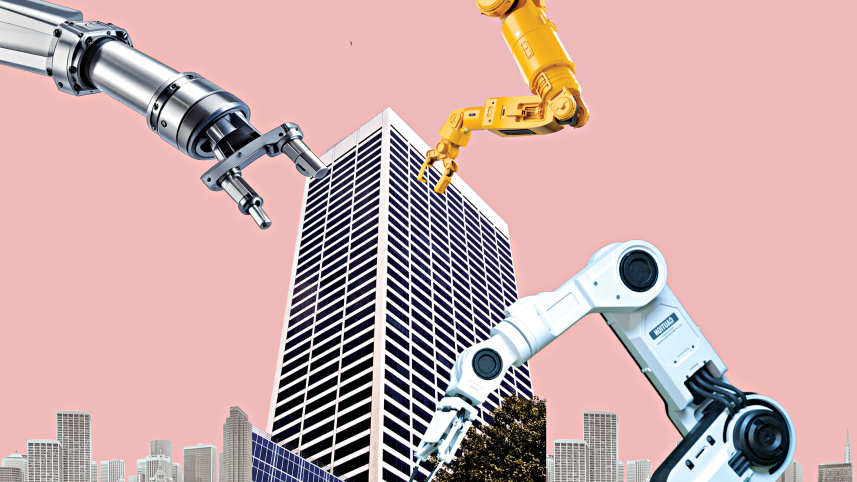

illustration: Adrin Sarwar
For decades, the construction site has been a place of grit, sweat, and significant risk. According to the International Labour Organization (ILO), construction accounts for a staggering 20 per cent of workplace fatalities worldwide. But a “robotic reformation” is underway. From the skyscraper projects to bridge repairs, robots are becoming the new “safety shield” for human workers.
Eliminating the Risk
The primary goal of these robots is to remove humans from the “danger zone” completely. This is the most effective form of safety: if the worker isn’t near the hazard, they can’t be hurt. Whether it is exploring a deep tunnel or entering a crumbling structure, a machine is now sent to do the dangerous work while the human operates it from a safe distance.
Brokk and Husqvarna DXR
In traditional demolition, a worker is seen with a jackhammer, exposed to falling concrete, heavy vibrations, and toxic dust. Today, remote-controlled robots like the Brokk or Husqvarna DXR are the industry standard. These machines crawl into dangerous, unstable buildings while the operator stands up to 300 feet away with a joystick. If the roof collapses, a machine is crushed, but a life is saved.
Boston Dynamics’ “Spot”
On massive sites or projects, a bright yellow, four-legged robot is often seen wandering the site. This is Spot. Equipped with 360-degree cameras and LiDAR(Light Detection and Ranging). Spot performs site inspections and “hazard mapping.” It can enter confined spaces or gas-filled areas to check for safety before humans set foot inside.
TyBOT
Tying rebar (the steel mesh inside concrete) is one of the most back-breaking jobs in construction. It can lead to chronic spinal injuries. A robot called TyBOT, created by Advanced Construction Robotics, is now used on major bridge projects. It autonomously identifies rebar intersections and tying them with steel wire.
ICON’s Vulcan
3D printing is moving from the lab to the job site. Companies like ICON use the Vulcan printer to “print” the walls of entire homes using a concrete composite. This removes the need for workers to climb high scaffolding or lift heavy masonry blocks. It reduces the risk of falls, one of the leading causes of death on construction sites.
The New Risk
While these machines save lives, they aren’t perfect. Despite becoming industry standards, the risk of accidents during Human-Robot Interaction (HRI) remains. If a robot’s sensors are blocked by dust or a software glitch occurs, the machine could collide with a worker. To avoid this, competency-based training is essential. Workers are now being trained in Virtual Reality to communicate with robots. Safety in this era isn’t just about the machine; it’s about prevention. Predictive maintenance can stop accidents before they occur.